

NEW DELHI: As the Digital India programme completes its 11th year, one of its most profound success stories is unfolding far from the tech hubs—in villages and small towns where millions of women entrepreneurs are leveraging digital commerce to transform their livelihoods.
At the epicenter of this rural revolution is eSaras, a government-backed digital commerce platform. Developed by the Digital India Corporation (DIC) under the Ministry of Electronics and Information Technology (MeitY) and the Ministry of Rural Development (MoRD), eSaras is implemented under the crucial Deendayal Antyodaya Yojana – National Rural Livelihoods Mission (DAY-NRLM).
Designed as an end-to-end digital marketplace, the platform enables Self-Help Groups (SHGs), women entrepreneurs, and Farmer Producer Organisations (FPOs) to showcase and sell their authentic rural products directly to customers nationwide.
A Digital Marketplace with Grassroots Impact
Over the past few years, eSaras has rapidly emerged as a dominant force in rural entrepreneurship.
Today, the initiative’s scale is massive:
-
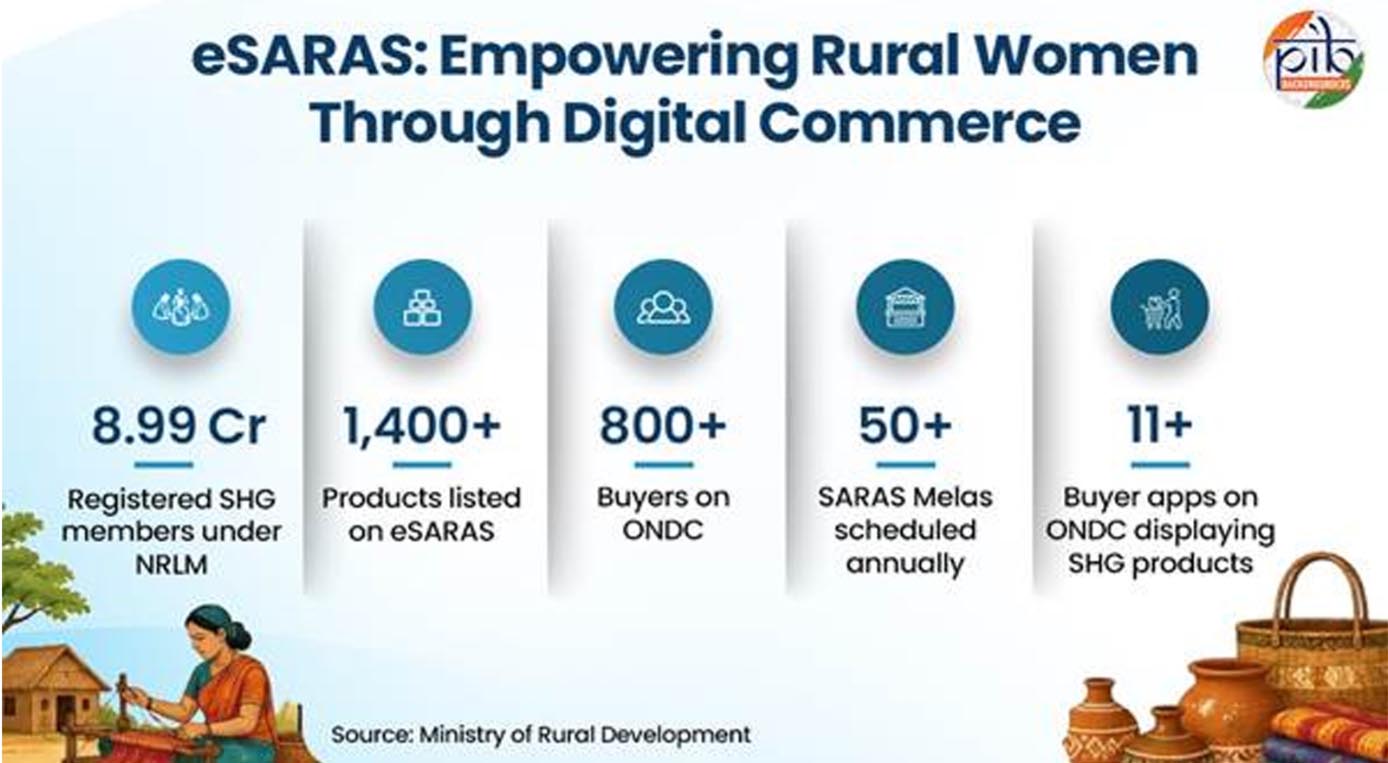
It covers more than 8.99 crore registered SHG members, making it one of the world’s largest women-led livelihood ecosystems.
-
The platform actively offers more than 1,400 distinct products.
-
SHG products are fully integrated with the Open Network for Digital Commerce (ONDC), accessible through 11 or more buyer applications.


To complement these online sales, the government also organizes over 50 physical ‘SARAS Melas’ annually, providing a hybrid approach to marketing rural products.
Creating Year-Round, Value-Added Livelihoods
Agriculture remains the primary income source for millions of rural households, but its highly seasonal nature leaves families vulnerable. eSaras specifically addresses this challenge by helping SHGs diversify their income streams throughout the year.
The platform aggressively promotes a wide variety of non-farming livelihood activities. More importantly, it actively encourages rural entrepreneurs to process raw agricultural produce into higher-value products.
Instead of selling raw produce, women are trained to process, package, and brand items such as:
-
Millet-based food products, packaged spices, pickles, and jams.
-
Handicrafts, bamboo and cane crafts, and terracotta products.
-
Handloom sarees, shawls, and cotton garments.
-
Herbal soaps, essential oils, honey, and dairy products.
This value-addition approach extends shelf life, drastically improves quality, and ensures significantly higher market returns for the producers.
Building Digital Entrepreneurship Skills
Recognizing that technology alone cannot transform livelihoods, DAY-NRLM provides extensive, hands-on training to the women associated with the platform.
The comprehensive training programs cover:
-
Digital onboarding and product listing
-
Branding, packaging, and product photography
-
Digital marketing and inventory management
-
Financial literacy and complex logistics management
By combining robust digital infrastructure with deep capacity building, eSaras is nurturing an entirely new generation of independent, rural digital entrepreneurs. This effort directly supports the government’s ambitious vision of creating 6 crore ‘Lakhpati Didis’ by 2029.
DPI at Work: The Success of Khurja Pottery
The platform utilizes India’s robust Digital Public Infrastructure (DPI) to ensure seamless operations. It integrates with UMANG, secure payment gateways, and multilingual services powered by BHASHINI, making digital commerce accessible across different regions and languages.
The tangible impact of these systems is reflected in the success of the Falak Self-Help Group from Khurja, Uttar Pradesh.
Renowned for their GI-tagged Khurja Pottery, the group’s sales were previously confined to local exhibitions. Over the past three-and-a-half years, eSaras has enabled them to reliably ship their fragile, handcrafted pottery to customers across India. The digital marketplace has significantly expanded their customer base, drastically enhancing their livelihood while preserving a traditional Indian craft.
As Digital India looks toward the future, eSaras stands as a powerful testament to how digital public infrastructure can be successfully leveraged to drive inclusive, grassroots economic growth.