

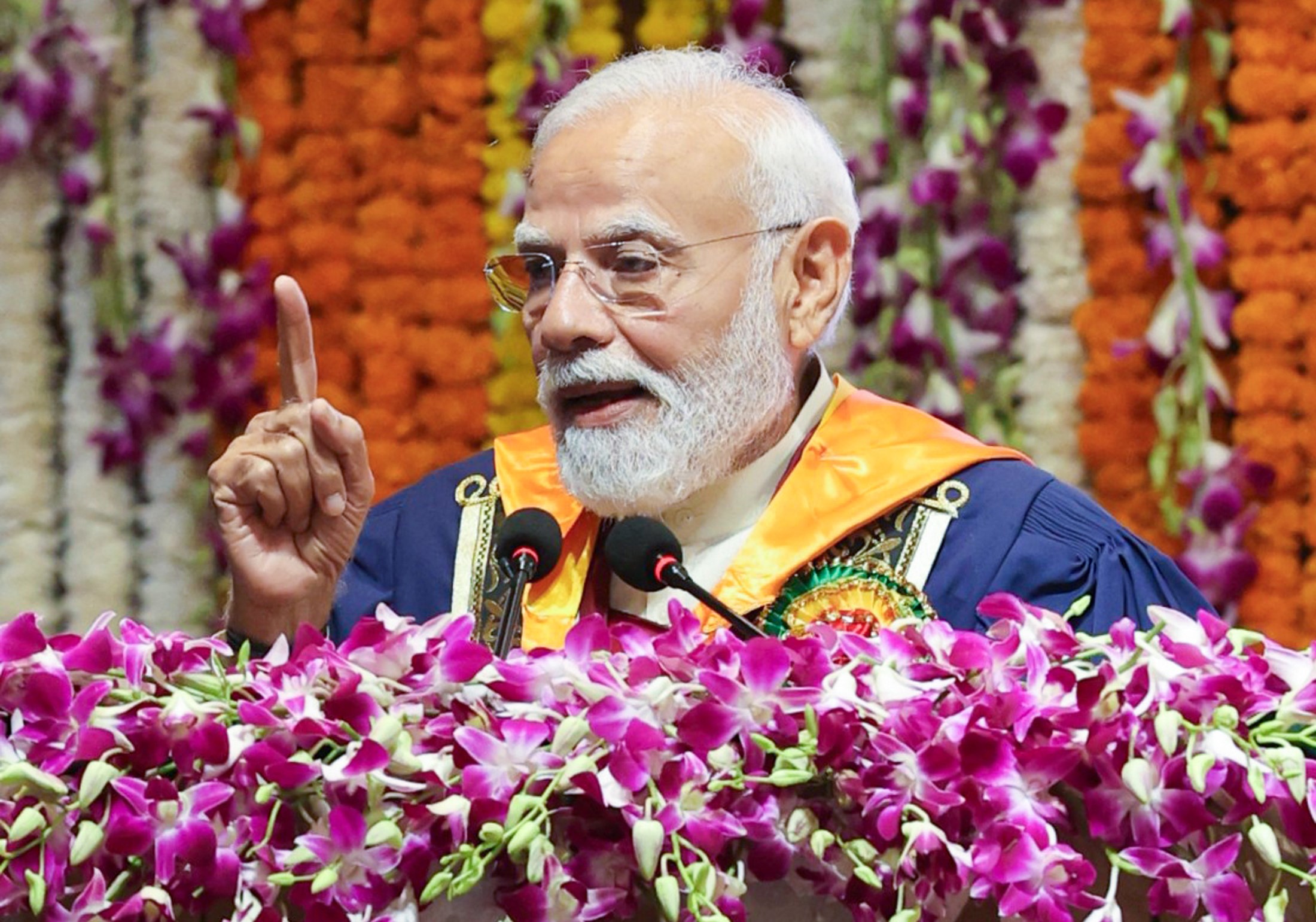
NEW DELHI: Prime Minister Narendra Modi on Saturday urged graduating students of the Indian Institute of Technology (IIT) Delhi to continuously learn, tackle complex challenges, and align their careers with the country’s development goals as India moves towards becoming a ‘Viksit Bharat’.
Addressing the 57th Convocation Ceremony of IIT Delhi, PM Modi said the graduates were stepping into a rapidly changing world where technological advances and geopolitical shifts would create both challenges and massive new opportunities. Over 3,000 graduating students, including 587 PhD scholars, were conferred their degrees during the ceremony.
Recalling his earlier virtual participation in an IIT Delhi convocation during the COVID-19 pandemic, the Prime Minister expressed his joy at being physically present on the campus. He urged the students to cherish their campus memories—including historic hostel rivalries involving Kumaon, Ara, Vindhy, Nilgiri, Kailash, and Himadri—as well as local food favorites like Jia Sarai’s poha and Satpura mess parathas.
‘Those Who Keep Learning Will Succeed’
Referring to rapid technological advancement and changes in the global strategic landscape, Modi said the pace of transformation was creating an era of both uncertainty and immense opportunity.
“Today, the world is changing rapidly. Nobody can say what will happen 20-30 years from now… Amidst all this rapid change, remember my words: the one who continuously learns is the one who will win,” PM Modi stated.
The Prime Minister emphasized that an IIT degree should not be viewed merely as a pathway to a high CGPA or a lucrative placement, but as a recognition of the graduate’s ability to solve complex problems. Drawing a parallel between academic challenges and real-life difficulties, he advised students to break large problems into smaller, manageable components.
He cautioned graduates that unlike academic examinations, many of life’s most important challenges would be “out of syllabus,” and true success would come from identifying and solving problems that society had stopped questioning.
Space, Semiconductors, and AI
Highlighting the massive growth of India’s space sector following recent government reforms, PM Modi said young engineers are increasingly designing and launching rockets, creating opportunities in an area once dominated by a handful of countries.
He also pointed to the rapid expansion of semiconductor manufacturing in India, noting that initial production facilities are already operational. “I firmly believe that from chips to ships, everything will be made here by your hands,” the Prime Minister remarked.

Looking ahead, PM Modi identified key areas where India would desperately need young talent and innovation, including:
-
Artificial Intelligence and Quantum Computing
-
Data Centres and Deep-Sea Exploration
-
Critical Minerals and Energy Security
-
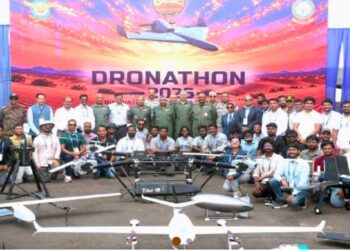
Drone Technology (Agriculture, Medical Delivery, and Defence)
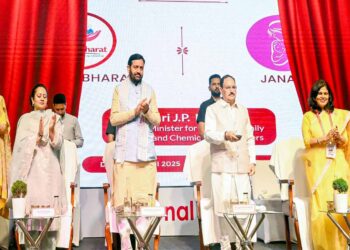
In a significant boost to these goals, PM Modi inaugurated Param Pragya, an AI-powered high-performance supercomputing facility at IIT Delhi’s Sonipat campus, aimed at strengthening advanced research infrastructure.
Aligning Decisions with National Needs
Recalling the sacrifices made by earlier generations for India’s independence, PM Modi said each generation has its own defining responsibility. He urged the graduates to use the next three decades of their professional lives to actively contribute to the country’s development.
“The basis of every decision of yours should absolutely be what the benefit to the country will be and which national need will be fulfilled,” he urged.
The Prime Minister cautioned students against comparing their salaries, placements, or startup achievements with those of their peers, particularly in an era dominated by social media. He encouraged them to focus on personal growth while prioritizing their mental and physical well-being.
“Remember, life is absolutely not a leaderboard; your real race is not with anyone else, it is with yourself,” PM Modi concluded, wishing the graduates a bright and successful future.