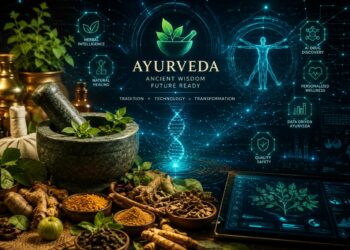



NEW DELHI — Ayurveda is rapidly transitioning from a regional traditional knowledge system into a globally recognized framework for health and wellness. With the 11th Ayurveda Day approaching on September 23, India is intensifying efforts to back its traditional medicine practices with modern scientific evidence, rigorous quality standards, and deep international cooperation.
The push for global acceptance is supported by a massive domestic economic boom. Over the past decade, the Ayush sector has experienced unprecedented growth. The market size has surged from $2.85 billion in 2014 to a staggering $43.4 billion in 2023, while Ayush exports have doubled from $1.09 billion to $2.16 billion over the same period.
A Strong Domestic Foundation
Before expanding outward, Ayurveda has solidified its base at home. The first exclusive All-India Survey on Ayush, conducted by the National Sample Survey Office (NSSO) between 2022 and 2023, revealed nearly universal awareness of Ayush systems—94.8% in rural areas and 96% in urban centers.
Furthermore, roughly half the country’s population (46.3% of rural and 52.9% of urban residents) utilized Ayush treatments for prevention or healing within the preceding year. Ayurveda emerged as the most preferred system, underlining its critical role in India’s preventive healthcare ecosystem.

Driving Medical Value Travel with the ‘Ayush Visa’
India is strategically positioning Ayurveda as a cornerstone of its medical tourism sector. Recognizing the international demand for holistic healthcare, the government introduced a dedicated Ayush Visa in July 2023 specifically for foreign nationals seeking traditional treatments in India.
-
Tourism Synergy: The government has partnered with the India Tourism Development Corporation to map out specialized tourism circuits centered around Ayurveda.
-
Economic Potential: With the global medical value travel market projected to hit $286.1 billion by 2030, integrating Ayurveda with wellness services and tourism presents a massive economic opportunity for the country.
NITI Aayog’s Vision for 2047
To sustain this momentum, NITI Aayog released its highly anticipated “Strategic Roadmap for Making Ayurveda Global” in July 2026.
Charting a pathway to 2047, the roadmap mandates a shift toward internationally recognizable regulatory frameworks. It emphasizes the necessity of robust clinical research, standardized product quality, and the cultivation of highly trained professionals to build global consumer confidence in Ayurvedic products and services.
Landmark WHO Partnerships and Global Integration
India’s domestic policies are deeply intertwined with the WHO Global Traditional Medicine Strategy 2025-2034, which focuses on safety, regulation, and evidence-based integration into national health systems.
Key milestones in this global cooperation include:
-
WHO Global Traditional Medicine Centre: Established in Jamnagar, Gujarat in 2022, with India committing $250 million as the lead investor. The center focuses on data analytics, sustainability, and scientific evidence.
-
Global Summits: Following the 2023 Gujarat Declaration, New Delhi hosted the second WHO Global Summit on Traditional Medicine in December 2025. The summit yielded the “Delhi Declaration” and actionable SMART commitments to restore balance for people and the planet.
-
ICD-11 Classification: In January 2024, the WHO formally included Ayurveda, Siddha, and Unani in Module 2 of the International Classification of Diseases (ICD-11). This allows traditional medicine morbidity codes to be documented in an internationally comparable framework, a massive step toward systemic integration, even as the WHO emphasizes that inclusion requires ongoing scientific validation.
The Future: Grounded in Research
The responsible globalization of Ayurveda ultimately hinges on credible data. The Ministry of Ayush currently hosts over 43,000 research entries on its Ayush Research Portal. This expanding body of evidence is vital for standardizing treatments and proving clinical efficacy to an international audience.
As India prepares to observe Ayurveda Day on September 23, the message is clear: the future of traditional medicine relies not just on ancient wisdom, but on bridging that knowledge with scientific innovation, uncompromising quality, and global cooperation.