

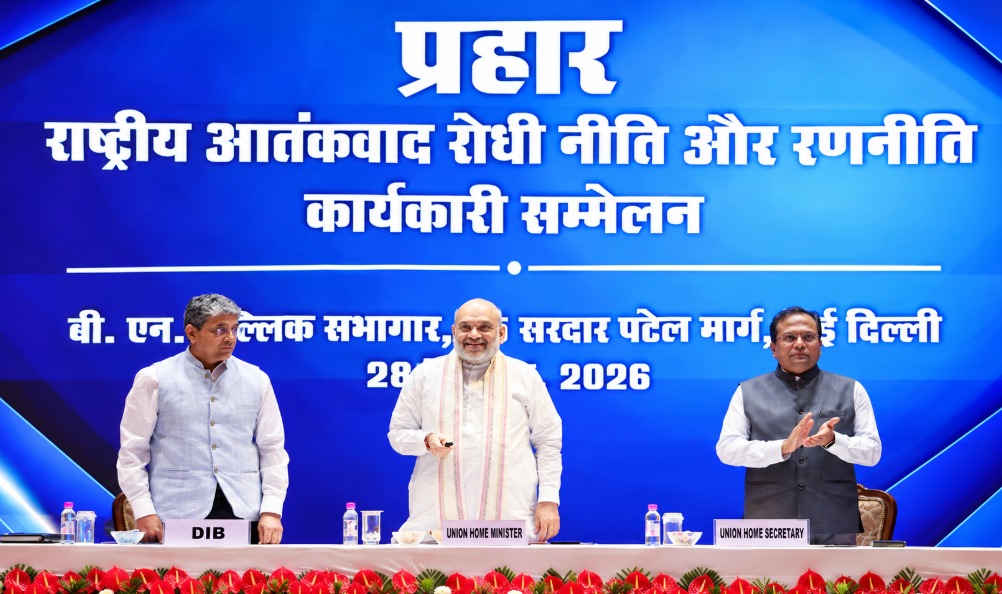
NEW DELHI: Union Home Minister Amit Shah on Monday launched a new Extradition Portal designed to synergize and expedite efforts to bring fugitives from abroad back to India.Inaugurating the high-level conference on ‘PRAHAAR – CT Policy and Strategy’ in New Delhi, Shah announced that 288 fugitive criminals have been successfully brought back to India from 36 countries between 2019 and 2026.
Zero Tolerance and Major Crackdowns
Highlighting the government’s firm ‘zero-tolerance’ policy towards all forms and manifestations of terrorism under the leadership of Prime Minister Narendra Modi, the Home Minister shared recent successes in inter-agency coordination.
He cited the major dismantling of the Shahzad Bhatti network, which was deeply involved in the cross-border smuggling of weapons, explosives, and narcotics. Key operational highlights included:

-
Busting more than 40 modules of the illicit network.
-
Registering over 100 FIRs and arresting 350 individuals across 15 states.
-
Officially declaring the Shahzad Bhatti network a terrorist organization under the Unlawful Activities (Prevention) Act (UAPA).
The PRAHAAR Strategy at the Grassroots
The national conference deliberated extensively on the seven core pillars of the PRAHAAR framework through a whole-of-society approach:
-
Prevention
-
Response
-
Aggregating Internal Capacities
-
Human Rights
-
Attenuating Conditions for Terrorism
-
Aligning International Efforts
-
Recovery & Resilience
Shah stressed the critical need to push the counter-terrorism strategy down to the local police station or ‘thana’ level. He urged all stakeholders to adopt a proactive, result-oriented approach toward every aspect of the PRAHAAR framework to prevent any delay in administrative or kinetic action.
Institutionalizing Counter-Terrorism Responses
Calling for an automated counter-terrorism response at every level, the Home Minister urged State Police Forces to establish dedicated teams that can work in close coordination with central agencies to expedite the extradition process. He also emphasized the need for the continuous analysis of terror incidents to strengthen the PRAHAAR mechanism and make it increasingly effective over the next decade.
The critical security conference was attended in person by the Union Home Secretary, Foreign Secretary, heads of CAPFs/CPOs, Directors General of Police (DGPs) from 15 states, and the Anti-Terrorism Squad (ATS) chiefs of all states and Union Territories. Other state DGPs and senior police officers joined the comprehensive deliberations virtually.