

DANGYARI/KASAULI : The Tethys Fossil Museum & International Geoheritage Research Center in Dangyari has urgently called for a community-based approach to conserve the approximately 150-million-year-old fossil heritage of Langza and Komic in the Spiti Valley.
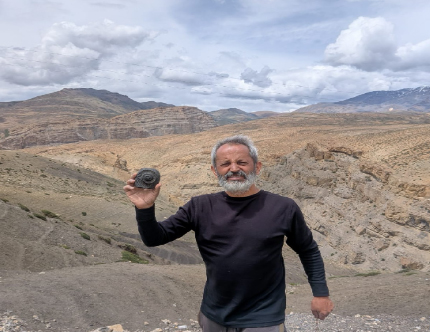
Dr. Ritesh Arya, a renowned geologist, palaeontologist, and Founder of the Tethys Fossil Museum, recently visited the high-altitude villages located at elevations of around 14,000–15,000 feet. He highlighted that the region preserves a rich and highly significant marine fossil record of the ancient Tethys Ocean, which includes remnants of ammonites, belemnites, bivalves, gastropods, brachiopods, and crinoids.
A Legacy Two Centuries Old
The scientific history of Spiti’s fossils spans nearly two centuries. In 1821, Dr. James Gerard made the first substantial recorded collection of fossils from the Spiti region at an elevation of about 4,900 metres. His collection generated widespread scientific interest regarding the presence of marine fossils at such extraordinary elevations. Following Gerard, prominent scientists including Blanford, Stoliczka, Oppel, Griesbach, and Diener made major contributions to the study of Spiti’s geological succession.
Historically, local villagers have intimately known the fossil-bearing slopes. In the past, the collection and sale of these fossils provided supplementary income for the locals. However, with the implementation of restrictions on fossil collection and trade, this activity has largely vanished.
“The question is not whether banning was right or wrong. The question is whether banning alone can provide a long-term solution for fossil conservation,” Dr. Arya emphasized.
Proposed Heritage Committee and Citizen Palaeontologists
To address the ongoing conservation challenges, Dr. Arya has proposed examining the feasibility of establishing a Langza Fossil Heritage Committee. This proposed body would actively involve the local community, district administration, the Geological Survey of India, and various scientific institutions.
Under this vision, local youth could be officially trained as “citizen palaeontologists” and geoheritage guides. Their role would be to document the fossils and help visitors understand the site’s scientific significance, strictly operating within the applicable legal frameworks.
Geoheritage Recognition Must Prompt Action
Recently, the Geological Survey of India officially declared the “Marine Fossil Treasure, Langza Village” in Lahaul and Spiti as one of India’s vital Geoheritage Sites. Dr. Arya stated that this prestigious recognition must now be immediately followed by visible conservation efforts, proper scientific interpretation, and widespread public awareness campaigns at the site.

He further called for the establishment of a dedicated Geological and Fossil Museum at Langza, alongside in-situ conservation of selected fossil-bearing exposures. These efforts should be supported by scientifically prepared geoheritage signboards explaining the nature of the fossils, the ancient Tethys Ocean, and the overall geological evolution of the mighty Himalayas.
According to Dr. Arya, combining a local museum, protected fossil sites, knowledgeable local guides, and rigorous scientific documentation could successfully transform Langza into a model geoheritage destination for the rest of the world.
“The villagers of Langza and Komic were field palaeontologists in their own way. We should train them, document what they find, and make them the true custodians of their geological heritage,” Dr. Arya concluded.