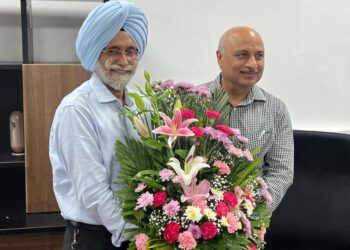



Chandigarh: The Division of Biotechnology and Molecular Medicine (BioMMed), Louisiana State University (LSU), successfully conducted a high-impact Continuing Medical Education (CME) programme at the ENT Department of the Postgraduate Institute of Medical Education and Research (PGIMER), Chandigarh, focusing on the growing role of Artificial Intelligence (AI) in biomedical research. The programme placed special emphasis on ENT cancers, viral oncology and the future of biomedical workforce development.
The CME was organised on the formal invitation of Dr. Jaimanti Bakshi, Head of the ENT Department, PGIMER, and witnessed enthusiastic participation from clinicians, researchers, faculty members, residents and trainees. The event provided a comprehensive platform to discuss how AI-driven approaches are transforming cancer research, diagnostics and translational medicine.
The scientific sessions featured expert talks by senior members of LSU BioMMed. Ojasvi Dutta, Assistant Director and Program Manager, delivered the keynote address on AI-enabled biomedical research ecosystems, viral oncology and data-driven training models for building the next-generation healthcare workforce. Sonalika Ray, Research Consultant at LSU, spoke on integrating AI and data science into translational cancer research, highlighting the importance of reproducibility, scalable analytics and cross-disciplinary collaboration.
Adding a cutting-edge perspective, Dr. Harikrishnan Mohan, Senior Postdoctoral Fellow at LSU BioMMed, elaborated on the role of CRISPR-Cas9 technology and its emerging applications in cancer therapy.

A major highlight of the CME was the interdisciplinary collaboration with the Department of Computer Science, Punjab Engineering College (PEC). Faculty interactions stressed the need for strong clinician–engineer partnerships to develop large language model (LLM) tools and AI applications tailored to real-world clinical challenges in ENT and oncology.
The programme reflected LSU BioMMed’s commitment to strengthening global academic partnerships, promoting translational research and nurturing a future-ready biomedical workforce through innovative, machine-learning powered approaches. The collaboration between PGIMER, LSU and PEC showcased a powerful model of integrating clinical excellence with computational expertise for advancing cancer care and biomedical innovation.